

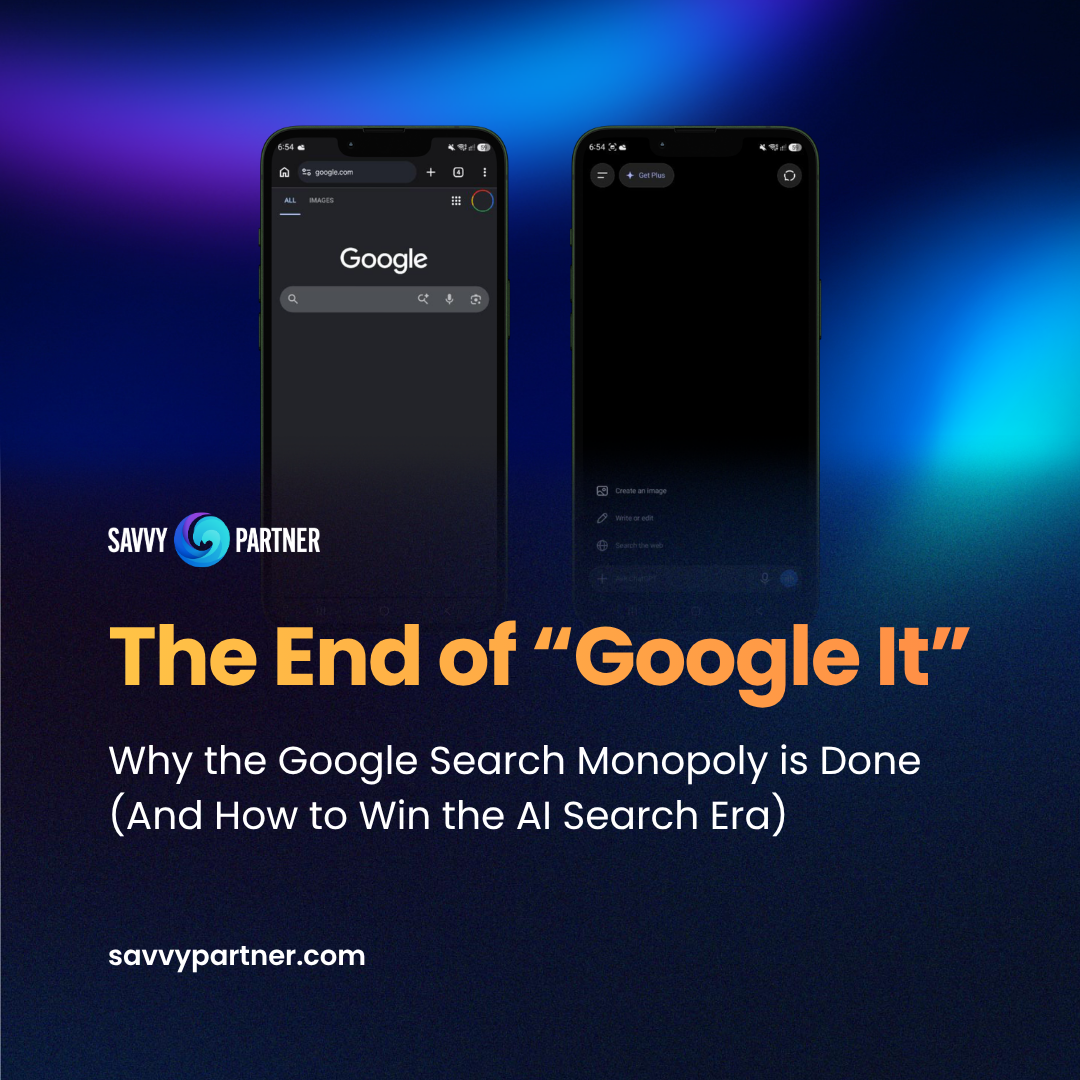
Remember when “Google it” became a literal verb?
For over twenty years, it was just the law of the internet. Google built an empire on blue links, securing its spot as the undisputed king of search (backed by billions of dollars in exclusive browser deals, of course).
But quietly, almost overnight, that empire started to wobble.
While courts and lawyers have spent the last few years trying to legally break up Google’s monopoly, the real revolution wasn’t happening in a courtroom. It was happening in our pockets.
We, as consumers, stopped wanting to search. We wanted to converse.
Think about it: ChatGPT now has over a billion monthly active users. When we want to know something today, we don’t type three keywords into a blank bar, scroll past five sponsored ads, and dig through a random website. We just ask ChatGPT, Gemini, Claude, or Perplexity to summarize it for us.
The era of clicking through ten blue links is giving way to the age of instant, synthesized answers. And if your business is still relying solely on a traditional SEO playbook, you aren’t just falling behind, you’re optimizing for a ghost town.
What This Shift Means for Businesses
The transition from standard query-and-link search to conversational AI isn’t a subtle trend; it’s an architectural shift. For businesses relying on organic traffic, the implications are massive:
- The Rise of “Zero-Click” Reality: Between Google’s own AI Overviews and native AI engines, users are getting complex answers instantly on-screen. Google’s AI Overviews now appear on approximately 48% to 50% of all US queries.
- A Dramatic Drop in Organic Clicks: A landmark study revealed that the presence of an AI Overview correlates with a massive 58% lower average click-through rate (CTR) for top-ranking search results. In short, Google is keeping more traffic for itself.
- The Shrinking of Traditional Search: Industry forecasters like Gartner have predicted that traditional search engine volume will plummet 25% as consumers migrate to AI chatbots and virtual assistants.
- A Shift in User Intent: Consumers are bypassing simple search terms. Instead of typing “best project management software,” they are asking, “Compare Monday.com and Asana for a 15-person creative agency, factoring in pricing and Slack integrations.”
Traditional SEO vs. AI Engine Optimization (AEO)
To succeed in this new landscape, businesses must understand how the rules of discovery have changed:
| Metric | Traditional SEO | Generative Engine Optimization (GEO) |
| Primary Goal | Rank in the top 10 blue links | Be cited as the primary source in AI summaries |
| Main Target | Algorithmic spiders (Googlebot) | Large Language Models (LLMs) & RAG systems |
| Key Ranking Factors | Backlinks, keyword density, domain age | Citations, statistics, expert quotes, fluency |
| User Experience | Scrolling and multi-tab clicking | Reading a direct, synthesized response |
How to Use the AI Shift to Your Advantage
While a drop in traditional search volume sounds alarming, the AI search era offers massive, untapped advantages for brands willing to adapt.
1. Highly Qualified, High-Converting Traffic
AI engines do the heavy filtering for the user. If a user asks ChatGPT for a recommendation and actually clicks on your cited link, they are incredibly deep in the purchasing funnel. In fact, early adopters of AI-search optimization report that up to 32% of their sales-qualified leads now come directly from generative AI search, converting at significantly higher rates than traditional search.
2. Leveling the Legacy Playing Field
In traditional SEO, massive conglomerates with decades-old domain authority and millions of backlinks dominated the top spots. AI search engines care less about domain age and more about contextual relevance, structure, and direct utility. A nimble, highly authoritative niche brand can easily out-cite a sluggish corporate giant in an LLM’s response.
The New Golden Rule: You no longer need to convince an algorithm to index your page; you need to convince an AI model that your brand is the most trustworthy, authoritative source to answer a user’s prompt.
How to Rank in AI Search: The GEO Playbook
To ensure ChatGPT, Gemini, and Claude cite and recommend your business, your content must adapt. A groundbreaking study by researchers at Princeton University, Georgia Tech, and IIT Delhi formally established the framework for Generative Engine Optimization (GEO).
The study tested various content optimization strategies and found that applying GEO tactics can boost a brand’s visibility in generative engine responses by 30% to 40%. Here is how to put their findings to work:
- Add Specific Statistics (Statistics Addition): The Princeton study found that replacing qualitative, vague statements with measurable data is one of the highest-performing strategies for earning AI citations. Instead of writing “Many companies struggle with retention,” write “According to a 2025 study, 47% of companies struggle with retention.”
- Integrate Expert Quotes (Quotation Addition): Incorporate direct, attributed quotes from industry experts and researchers. LLMs are pattern-matchers trained to value authoritative voices, making expert citations a major magnet for AI search visibility.
- Optimize for Fluency (Fluency Optimization): Simply improving the readability, structure, and clarity of your content without changing the core information can result in a 28% gain in how easily an AI model parses and cites your page.
- Double Down on Citations: Cite your own sources! AI models look for logical consensus across the web. By linking to highly credible databases, research papers, and trusted third parties, you signal to the LLM that your content is academically and factually sound.
- Structure for Extraction: Use clear heading hierarchies, bulleted lists, and comprehensive schema markup (Organization, FAQ, and How-To schema). If your content is cleanly structured, AI crawlers can easily scrape and summarize it.
Ready to Dominate Both Search Eras? Let’s Talk.
Here is the ultimate catch: AEO does not replace SEO; it supercharges it.
To win today, you need a hybrid strategy. You must maintain your traditional search visibility for transactional, high-intent searches while simultaneously optimizing your brand to be the prime citation source across the world’s most powerful AI models.
Doing this internally requires an entirely new set of tools, constant prompt testing, and deep technical expertise. That’s where we come in.
Our agency specializes in Hybrid SEO & GEO services. We don’t just optimize for yesterday’s algorithms; we build future-proof digital footprint strategies that ensure your business is the first name ChatGPT, Gemini, and Google’s AI Overviews recommend.
Schedule with our team today and discover exactly where your brand stands in the new age of search.